
Trump Recession Is Already Here
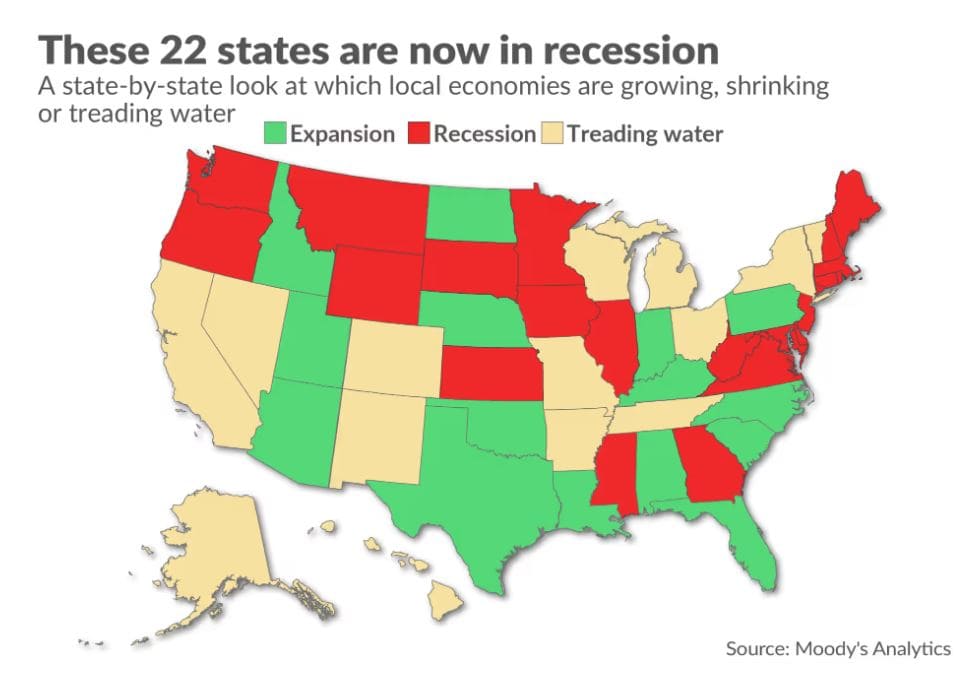
Signs of a recession are multiplying across the United States. Economists, business leaders, and data analysts now warn that the Trump-era recession is no longer a future threat—it’s already underway. Reports indicate that 22 states are already in recession, with job losses, declining consumer confidence, and business uncertainty piling up.
Before declaring a recession, it’s important to understand what economists look for:
-
Technical definition: Two consecutive quarters of negative real GDP growth.
-
Broader definition: A significant contraction across the economy lasting more than a few months, with declines in employment, income, industrial production, and retail sales.
-
Official arbiter: The National Bureau of Economic Research (NBER) considers a wide range of data, not just GDP, to mark recession dates.
When we say the recession is “already here,” we’re looking at leading indicators and real-time evidence suggesting contraction is underway or imminent.
Key Indicators Showing Recession
1. Weakening Job Market
-
Private reports show job losses in September 2025, a rare occurrence in recent years.
-
Long-term unemployment is rising, signaling early recession pressure.
-
Payroll growth has slowed, and past months were revised downward.
2. Declining Consumer Confidence
-
The consumer confidence index fell to 94.2 in September 2025, the lowest in months.
-
With consumer spending making up roughly 70% of GDP, this decline is a serious warning.
-
Americans are trimming spending due to worries about prices and jobs.
3. Policy and Structural Risks
-
Tariffs on imported goods raise costs for businesses and consumers.
-
Government shutdowns reduce spending and erode confidence.
-
Bridgewater’s Ray Dalio warns these moves have put the U.S. “close to a recession.”
4. Regional Recession Hits 22 States
-
Analysts report 22 states are already showing recession-like conditions, including major industrial and agricultural hubs.
-
This indicates the downturn is not isolated but spreading across the country.
5. Early GDP or Negative Growth Hints
-
In Q1 2025, U.S. GDP declined by –0.3% before new tariffs fully impacted the economy.
-
Experts argue that tariff-driven shocks may have started recessionary conditions as early as March 2025.
Evidence Against or Complicating the Claim
-
Some recent GDP quarters still show growth (e.g., 3.8% in Q2 2025).
-
Official data may lag, with the NBER waiting for robust confirmation.
-
Certain sectors like tech and services remain relatively resilient.
-
Tariff threats are occasionally delayed or paused, temporarily calming markets.
Despite these caveats, the balance of evidence suggests the U.S. is entering, or already in, an early-stage recession.
What This Means for Americans
-
Reduced job security and potential layoffs
-
Increased costs for goods due to tariffs
-
Slower economic growth impacting local businesses
-
Financial uncertainty in the coming months
The Bottom Line
While the official recession declaration may still be months away, real-time data suggests the Trump Recession is here, affecting millions of Americans. Weak jobs data, declining consumer confidence, tariff shocks, and a government shutdown have created an environment ripe for economic contraction.
Sources & References:
-
US ‘flying blind’ at critical moment for economy, experts warn, with no jobs data amid shutdown
-
US consumer confidence declines again as Americans fret over prices, job market
-
Bridgewater’s Ray Dalio says Trump trade war has put US ‘close to a recession’






Vintage Items






Funko Pop!

This analysis is spot on. I live in one of the states already hit by the downturn, and you can feel it in local businesses and job postings. It’s not just numbers on a chart—people are struggling. Do you think things will get worse before they get better?